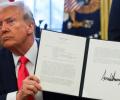
Industry insiders in India warn that any such move in the pharmaceutical sector could be counterproductive for the US as it may face increased drug shortages if tariffs are imposed on such imports.

Among the Sensex firms, Power Grid, ITC, JSW Steel, ICICI Bank, Tech Mahindra, Infosys, IndusInd Bank and Mahindra & Mahindra were the major laggards. Sun Pharma, Reliance Industries, HCL Tech, Hindustan Unilever, Bajaj Finance and Maruti were among the gainers.

For UK automakers, market access to India will be limited by quantity caps and phased tariff cuts, especially on petrol, diesel and electric vehicles.

'The government is actively engaging with EU to ensure that concerns of Indian companies and hard-to-abate sectors are adequately addressed under CBAM'

The heightened global uncertainty due to the US "reciprocal tariffs" on India may cause near-term corrections and market turbulence, but the long-term outlook remains constructive, market experts said on Thursday. The US has announced 27 per cent reciprocal tariffs on India, citing high import duties imposed by New Delhi on American goods.

Inflows into equity mutual fund (MF) schemes declined for the third month in a row in March even though the equity market recovered sharply. Equity MF schemes raked in a net Rs 25,082 crore in March, down 14 per cent from February.

While Elon Musk's political influence continues to grow, his business empire is witnessing headwinds.

China on Tuesday retaliated US President Donald Trump's imposition of 2nd round of ten per cent tariffs on its export by slapping an additional 15 per cent tariffs on American goods and initiated legal action against Washington in WTO while leaving the door open for talks to address each other's concerns.

Escalation of the conflict in West Asia between Israel and Iran has had a direct impact on the energy markets, and more broadly on the financial markets as well as the global economy.

The reopening of China has led to an ongoing readjustment of the global metals and commodities markets. China has a massive production capacity surplus to its own domestic demand. At the same time, it also has high domestic demand. China is also becoming carbon sensitive.

In the shadows of a sliding rupee, India's knitwear hub Tiruppur is weaving a success story. While the domestic currency edges closer to the 86 mark against the US dollar, triggering concerns for many sectors, this textile town in Tamil Nadu is finding opportunity in adversity: Between April and December alone, Tiruppur's exports reached Rs 26,000 crore, almost eclipsing last financial year's total of Rs 30,690 crore.
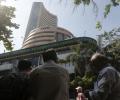
From the Sensex pack, Tata Consultancy Services, Reliance Industries, NTPC, Bharti Airtel, Power Grid, Larsen & Toubro, HDFC Bank, Kotak Mahindra Bank, Tech Mahindra and HDFC were the major laggards. Maruti, Tata Motors, Titan, UltraTech Cement, Bajaj Finserv, Mahindra & Mahindra, State Bank of India and IndusInd Bank were the biggest gainers.
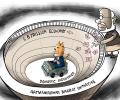
The Indian economy is on the path of a durable recovery on the back of conducive monetary and credit conditions, the global headwinds notwithstanding, said a Reserve Bank of India (RBI) article on the state of the economy. Domestically, there have been several positives on the COVID-19 front, in terms of reduced infections and faster vaccinations, the article published in the RBI Bulletin November 2021 added. The Indian economy, the article said, is clearly differentiating itself from the global situation, which is marred by supply disruptions, stubborn inflation and surges of infections in various parts of the world.

The rupee tumbled 3 per cent against the US dollar in 2024 as concerns over slower economic growth and a stronger greenback in global markets weighed, but it was among the least volatile currencies in the world and the headwinds may be less intense in the coming year.

Concerned over the fallout of the Red Sea crisis and severe shortage of containers against the backdrop of a steep decline in merchandise exports in August, the Union government is pulling out all the stops to find a solution. To begin with, the government has devised a strategy aimed at boosting container supply and supporting exporters.

State-owned Indian Strategic Petroleum Reserves Ltd (ISPRL), which operates India's strategic crude oil storage, will make awards by December to lease around 1 million tons of crude oil storage space (7.3 million barrels) at two of the country's three existing Strategic Petroleum Reserves (SPRs), around a fifth of the total SPR capacity. This will enable the refilling of crude caverns even as escalating hostilities in the Gulf threaten disruptions in crude supplies, two industry sources said.

Investors lost Rs 24.69 lakh crore in market valuation in the last four days of severe drubbing in the equity market. Spike in global crude prices, unabated foreign fund outflows, a strong US jobs data diminishing early rate cut expectations, and the rupee logging its steepest single-day fall in nearly two years dampened investors' sentiment.

'We have to be prepared for the larger disruption that is likely to take place.'

The trails of mega-mergers, tailwinds of expanding fleets, flights and airports will dot the fast-growing Indian aviation firmament in 2025, though the dark clouds of supply chain woes will persist longer. Also, new airline takeoffs, the future trajectory of revised norms to tackle pilot fatigue and efforts to reduce carbon emissions will be on the radar.

The recent depreciation of the rupee along with sharp fall in the country's foreign exchange (FX) reserves has sparked a debate whether stability of the exchange rate is necessary and desirable. The rupee was one of the least volatile currencies among peers for almost two years before the current downward pressure started in September after the US Federal Reserve lowered interest rate.

What's different this time is that global financial stress -- which has its genesis in four policy choices made in recent years -- is juxtaposed with a more resilient real economy, observes Sajjid Z Chinoy, chief India economist at J P Morgan.

India is expected to contribute 15 per cent to the global growth in 2023, an International Monetary Fund (IMF) official said on Tuesday. "Both India and China are expected to contribute 50 per cent of the global growth in the upcoming year (2023). "However, the share of India's contribution to global growth is expected to be around 15 per cent," Krishna Srinivasan, director, Asia and Pacific Department (APD) at IMF said at a roundtable with reporters from south Asian countries.

Withdrawing a blanket ban on overseas shipments of non-basmati white rice, the government on Saturday imposed a floor price of $490 per tonne and exempted the commodity from export duty. Exports of non-basmati white rice have been banned since July 20, 2023 to boost domestic supply. "The export policy for non-basmati white rice (semi-milled or wholly milled rice, whether or not polished or gazed) ...is amended from prohibited to free, subject to MEP (minimum export price) of $490 per tonne with immediate effect and until further orders," the directorate general of foreign trade (DGFT) said in a notification.

India is poised to be the fastest-growing major economy in the world and an engine of global growth despite global headwinds, says leading industrialist and Aditya Birla Group Chairman Kumar Mangalam Birla. The economic activity in India has witnessed a sharp recovery to pre-pandemic levels on the back of a rapid and widespread rollout of the vaccination programme, Birla said in the latest annual report of UltraTech Cement Ltd. "A strong digital ecosystem, fiscal and monetary policy and various government schemes helped small and medium enterprises and the worst affected sections of the population to survive while reviving demand and bringing the economy back on track," said Birla while addressing UltraTech's shareholders.

China's state-run Sichuan Airlines has suspended all its cargo flights to India for 15 days, causing major disruption to private traders' efforts to procure the much-needed oxygen concentrators and other medical supplies from the country despite Beijing reiterating its readiness to help India to deal with the latest surge of COVID-19 cases.

The further expansion and upgrade of the Chinese military does not augur well for India, which continues to confront an increasingly belligerent China on its borders, notes former foreign secretary Shyam Saran.

Delivering a thinly veiled message to Pakistan from its soil, External Affairs Minister S Jaishankar on Wednesday said activities across borders characterised by the 'three evils' of terrorism, extremism and separatism are unlikely to encourage trade, energy flows and connectivity.

India's e-commerce market alone is projected to reach $200 billion by 2026, making it a prime industry for ambitious entrepreneurs, explains rediffGURU Harsh Bharwani.

Top government officials in New Delhi have started discussions with stakeholders ranging from shipping and container companies to export promotion councils to understand the impact of the Iran-Israel tensions and plan ahead. Inter-ministerial talks are also being lined up amid the crisis situation in West Asia, sources confirmed. While the crude flows are not directly under any threat, elevated oil prices remain a concern, according to officials.

'We carry 6.5 billion passengers every year. We have crossed seven billion this year, and are targeting 10 billion by 2030.'

If the war in the Israel-Gaza region escalates into a larger West Asian conflict, it could pose problems.

Global financial markets are wrong in hoping that the worst is over in geopolitical crises such as the Iran-Israel conflict and the Russia-Ukraine war, wrote Christopher Wood, global head of equity strategy at Jefferies, in a recent note to investors called 'GREED & fear'. While most investors and the media are focused on United States (US) Federal Reserve policy and the "endless chatter" of Fed governors, Wood believes the news flow in the financial sphere "pales into complete insignificance" compared with the "tectonic shifts" going on in geopolitics.

The FMCG industry hopes for a revival in consumption growth in 2025 with some 'green shoots' already visible, after having a challenging year amid escalating input costs and a double-digit rise in food inflation, which ultimately slowed down the pace of the urban market growth in the second half of 2024. Soaring prices of commodities such as palm oil, coffee, cocoa and wheat forced FMCG players to go for a hike of 3 to 5 per cent or resort to shrinkflation by reducing pack sizes and grammage to retain attractive price points, fearing a volume loss.

NTPC, Maruti, SBI, PowerGrid, Bajaj Auto, UltraTech Cement and Axis Bank rose up to 2.95 per cent.
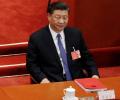
The just-concluded plenary session of the ruling Communist Party of China (CPC), headed by Xi, adopted his proposals for the formulation of the 14th Five-Year Plan (2021-2025) for National Economic and Social Development and the Long-Range Objectives Through the Year 2035.

The Russia-Ukraine conflict, which has spooked financial markets globally, will set the tone for Dalal Street this week amid concerns over energy prices and foreign fund outflows, analysts said. Participants will also track key macroeconomic signals like GDP estimates and PMI data for manufacturing and services sectors to be announced this week, they added. "With earnings season behind us and given the overall sentiments, markets are expected to move in sync with global peers in the coming week. "A close eye will be kept on the developments concerning the Russia - Ukraine crisis and considering the inflation overhang, market participants will also observe movements in energy prices," said Shrikant Chouhan, Head of Equity Research (Retail), Kotak Securities Ltd.

OSAT majors have concerns about India's ability to provide a stable, predictable, and lasting policy environment for years to come, which is key for making a decision in a capital-intensive business.

'The private sector believes that some enablers in labour-intensive sectors like apparel, toys, tourism, and media retail, can unlock a lot of jobs.'

Upbeat high-frequency indicators and consumer confidence show that Indian economy continues to forge ahead, emerging out of shackles of pandemic, said an article on the state of economy published in RBI Bulletin on Wednesday. The recovery is spearheaded by an uptick in private investment through November-December alongside a turnaround in bank credit offtake and high capex from the government sector (Centre and states). In conjunction, the employment situation has brightened, said the article written by RBI officials.

'The selling in India may emerge as soon as the RBI reverses its interest rate stance.'
